we use
US
・UK
A1 sơ cấp
v.t.ngoại động từChúng tôi sử dụng
We use this room for meetings.
v.t.ngoại động từChúng tôi tiêu thụ
We use a lot of electricity in this house.
v.t.ngoại động từChúng tôi quen dùng
We use the Oxford comma in our style guide.
Phụ đề video
Cách Từ Ngữ Có Thể Gây Tổn Thương: Crash Course Triết Học #28 (How Words Can Harm: Crash Course Philosophy #28)

- I'm talking about more prevalent language, the kind we use in the cafeteria, in dorms, when talking to our friends, or talking about our enemies.
Tôi đang nói về ngôn ngữ phổ biến hơn, loại chúng ta sử dụng trong căng tin, trong ký túc xá, khi nói chuyện với bạn bè, hoặc nói về kẻ thù của chúng ta.
- I'm talking about more prevalent language – the kind we use in the cafeteria, in the dorms, when talking to our friends, or talking about our enemies.
Cải thiện ngữ điệu tiếng Anh của bạn (Improve your English Intonation)

- Listen to this sentence said in two different ways I'm so excited to see you I'm so excited to see you There's a difference in the intonation the ups and downs of the voice Perhaps British English tends to move more compared to your native language Well today I'm going to show you how intonation works in standard British English and afterwards you can practice using my brand new pitch tracker When the vocal folds inside the larynx vibrate more quickly we hear a higher pitch This is high Slower vibrations create a lower pitch This is low The green lines here on my pitch tracker visualize the pitch and help you learn more quickly In English we use pitch patterns called tones to show our attitude and emotions It's like vocal body language The more emotional we are the wider the pitch range Compare these Tones even reflect the grammar They can help us distinguish a statement from a question You did it Let's break down the four main tone patterns you need to know We'll use the word more Repeat after me More More More More And again More More More More We'll go through these tones in turn The fall is used for statements Joe went to London Katie's in a meeting The tone usually starts on the stressed syllable of the final content word Content words are words with real meaning like nouns and verbs Here London and meeting are the final content words And the tone begins on the primary stressed syllable of these words London Meeting Joe went to London Katie's in a meeting I am my mother's daughter I am my mother's daughter The world is difficult to navigate The world is difficult to navigate If you think your voice is a bit flat This is the bit to change Start the fall relatively higher Listen to this difference I want to go to London I want to go to London I want to go to London I want to go to London We also use a falling tone for WH questions What's happening?
Hãy nghe câu này được nói theo hai cách khác nhau: "Tôi rất háo hức được gặp bạn" và "Tôi rất háo hức được gặp bạn". Có sự khác biệt trong ngữ điệu, tức là sự lên xuống của giọng nói. Có thể tiếng Anh Anh có xu hướng thay đổi nhiều hơn so với ngôn ngữ mẹ
- In English we use pitch patterns, called tones, to show our attitude and emotions.
Ở Bắc Mỹ, giọng điệu tăng dần khi hỏi câu hỏi ít phổ biến hơn. Nhưng ở Anh, chúng tôi rất thích sử dụng nó và nó thể hiện sự lịch sự. Xin lỗi, bạn có thể lặp lại điều đó được không?
Dùng danh từ chỉ bộ phận cơ thể làm động từ trong tiếng Anh! (Use Body Nouns as Verbs in English!)
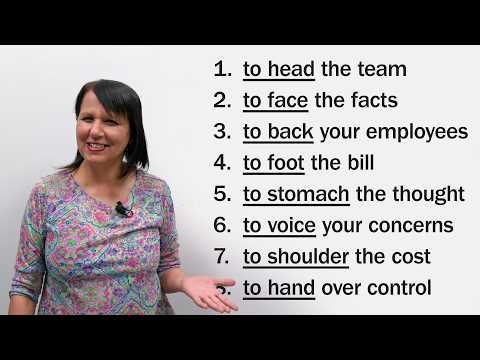
- and yes, they represent different body parts, but that's not what we mean when we use them.
và vâng, chúng đại diện cho các bộ phận cơ thể khác nhau, nhưng đó không phải là ý chúng ta muốn nói khi sử dụng chúng.
- and yes, they represent different body parts, but that's not what we mean when we use them.
và vâng, chúng đại diện cho các bộ phận cơ thể khác nhau, nhưng đó không phải là ý chúng ta muốn nói khi sử dụng chúng.
Phản hồi ngắn gọn để giao tiếp tiếng Anh tự tin nơi làm việc (Short Reponses For Confident English At Work)

- We use it informally with colleagues we know well.
Chúng ta dùng nó một cách thân mật với đồng nghiệp mà chúng ta quen biết rõ.
- We use it informally with colleagues we know well.
Ví dụ đầu tiên của chúng ta.
Thói quen đơn giản này sẽ giúp bạn nói tiếng Anh trôi chảy (có cơ sở khoa học) (This Simple Habit Will Make You Fluent in English (backed by science))

- And so with this habit, we use comprehensible input and we combine it with active learning.
Nó dễ hiểu đối với bạn.
- And so with this habit, we use comprehensible input and we combine it with active learning.
Và vì vậy, với thói quen này, chúng ta sử dụng đầu vào dễ hiểu và kết hợp nó với học tập chủ động.
Cách làm chủ nghệ thuật nói chuyện phiếm kiểu Anh (How to Master British Small Talk)

- We use a technique called the polite dodge.
Hôm nay đẹp quá phải không?
- We use a technique called the polite dodge.
Chúng ta dùng một kỹ thuật gọi là "né tránh lịch sự".
Cách trả lời mọi câu hỏi IELTS một cách trôi chảy (How to Answer Any IELTS Question Fluently)
- And we use connectors to connect our ideas, right?
Và chúng ta sử dụng các từ nối để kết nối ý tưởng của mình, đúng không?
- And we use connectors to connect our ideas, right?
Vì vậy, kết quả của điều này là, đó là lý do tại sao.
Lịch sử thực sự của Lễ Đình chiến Giáng sinh năm 1914 (The Real History of the Christmas Truce of 1914)

- Now, that's an expression we use when we're waiting for a bus.
Bây giờ, đó là một cách diễn đạt chúng ta dùng khi chờ xe buýt.
- Now, that's an expression we use when we're waiting for a bus.
Ngủ rất khó ở tuyến đầu, rất, rất khó.
JENNIE: Phỏng vấn Ruby với Zane Lowe (JENNIE: The Ruby Interview with Zane Lowe)

- and also the the different words that we use in the music world, Korean and English, is so different.
Nhớ đêm nay bây giờ tôi nhớ đêm nay.
- and also the the different words that we use in the music world, Korean and English, is so different.
Tôi nghĩ bài hát đã nói lên.
Những gì chúng ta nói thay vì "xảy ra" trong các tình huống khác nhau (What We Say Instead of “Happen” in Different Situations)
- However, there are important differences in how we use them,
Tuy nhiên, có những khác biệt quan trọng về cách chúng ta sử dụng chúng,
- However, there are important differences in how we use them,
Tuy nhiên, có những khác biệt quan trọng về cách chúng ta sử dụng chúng,